Industry
Designing Through an Agent: How Tools and the Profession Are Changing
For a long time, designers’ work has been organised around software. Each specialism has largely come with its own toolkit: Figma for interfaces, After Effects for animation, Premiere Pro for editing. Learning the profession has meant learning these environments — their capabilities, limitations and ways of achieving the desired result.
Agents introduce a different model. An intermediary sits between the person and the software, taking on tasks. It accesses tools, works with files, carries out sequences of actions and returns results for review.
If this model becomes widespread, the implications will extend well beyond completing individual operations faster. Applications will become infrastructure for agents, interfaces will be created for specific tasks, and designers will increasingly direct the creative intent and the process of execution.
An Agent Between the Designer and Their Tools
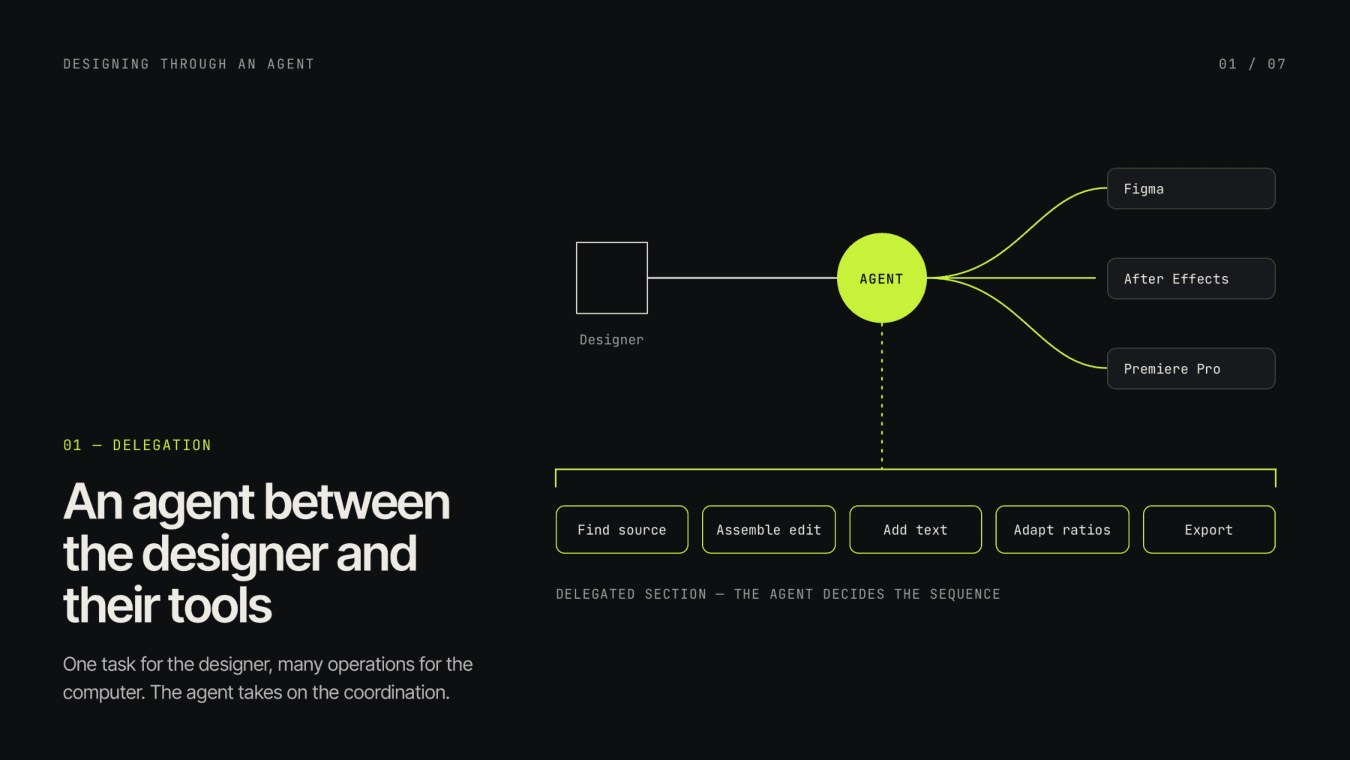
Consider a typical task: producing several versions of an advertising video. It involves finding source material, assembling an edit, adding text, adapting the composition to different aspect ratios and exporting the files.
For the designer, this is one task. For the computer, it is a collection of separate operations across several applications. The person usually connects them: transferring files, managing names, checking settings and starting exports.
An agent can take on a substantial part of this coordination. Given a task and access to the tools, it can draw up a plan, perform the available operations and present an intermediate result.
The significant change is the emergence of another level of control. An entire section of the workflow can be delegated, with the agent determining the sequence of actions within it. Its autonomy can vary, from following detailed instructions to preparing several possible solutions.
Software Becomes the Backend
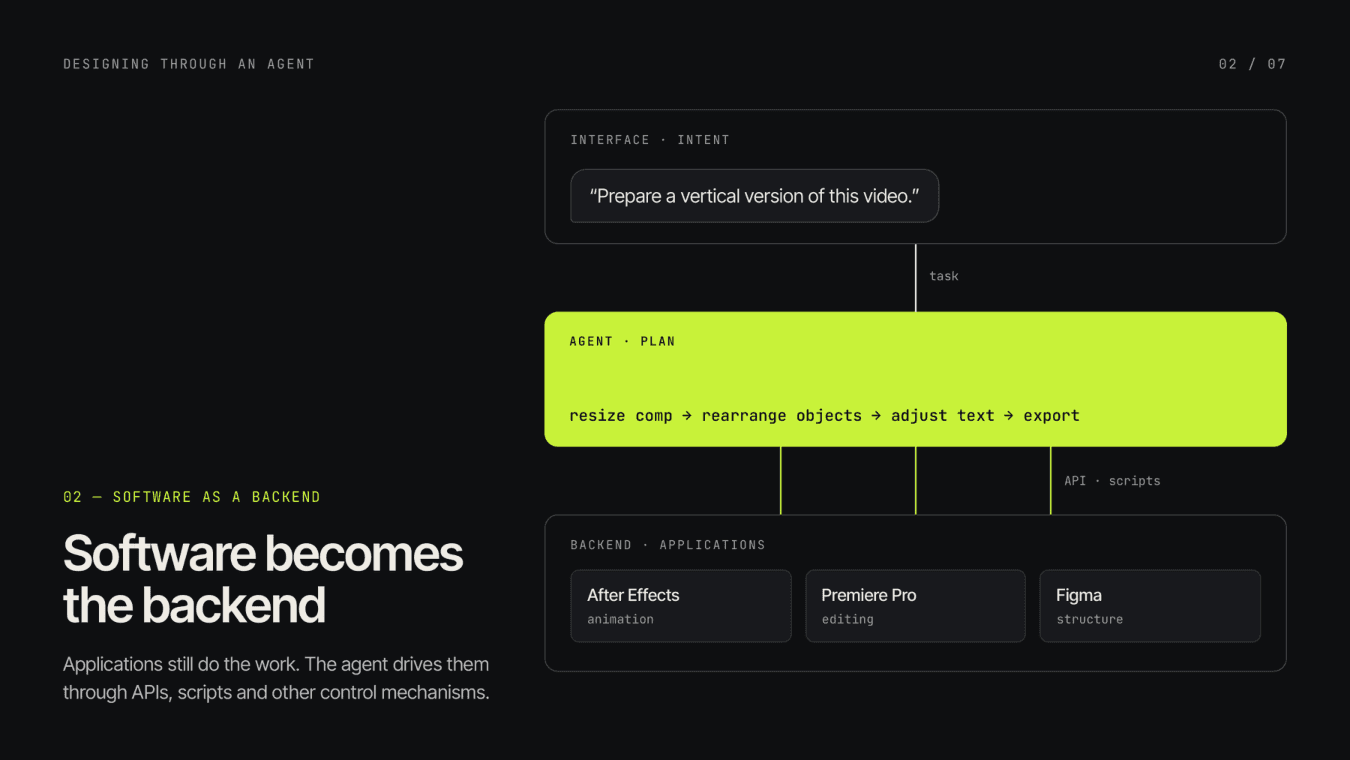
This model can be described as Software as a Backend. The backend is the part of a system that does the work behind the visible interface. Here, professional applications gradually take on that role in relation to the agent.
After Effects still calculates animation, Premiere handles editing, and Figma holds the structure of a design. But the person no longer needs to control every operation through panels and menus.
For example, “prepare a vertical version of this video” might involve changing composition dimensions, rearranging objects, adjusting text and exporting. The agent accesses the applications’ capabilities through APIs, scripts or other control mechanisms.
This does not necessarily mean applications will move to the cloud. Software can remain on the user’s computer while acting as an execution tool for an agent. Where computation happens and how someone interacts with it are separate questions.
In this system, software’s value increasingly depends on how accessible its capabilities are to an agent: whether it can inspect a project’s structure, change parameters, check the result and continue working without constant human intervention.
From Commands to Intent
The next shift concerns the language we use to interact with computers.
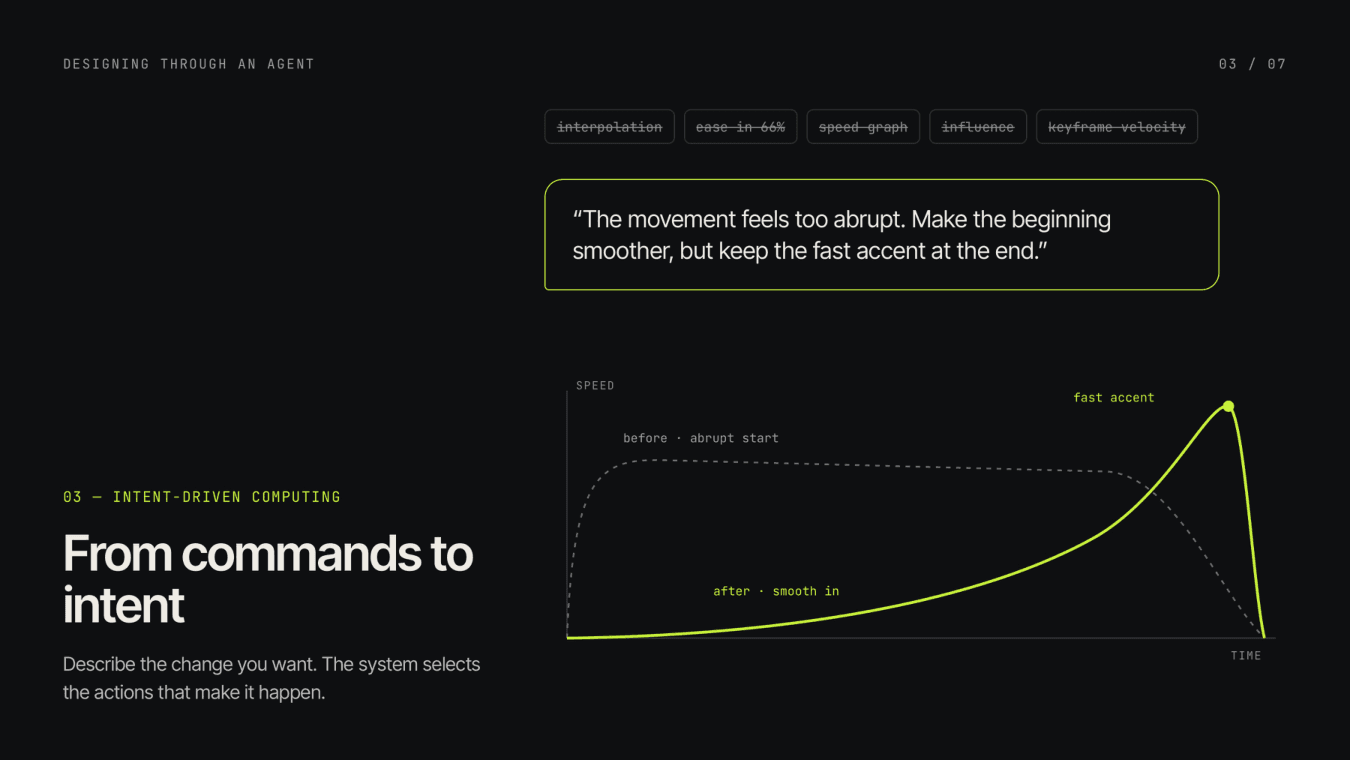
A traditional interface requires the designer to translate an idea into commands for a particular application. To make a movement feel smoother, they change interpolation, adjust speed curves and check acceleration and deceleration.
With an agent, they can begin with intent: “The movement feels too abrupt. Make the beginning smoother, but keep the fast accent at the end.”
This is Intent-driven Computing: interaction organised around what the user wants to achieve. The person describes the desired change, and the system selects the actions needed to make it.
Intent, however, almost always leaves room for interpretation. “Make it more dynamic” could mean more frequent cuts, faster movement, shorter pauses or stronger contrast between quiet and active moments. The agent needs context, and sometimes clarification or several options.
The quality of the interaction will therefore also depend on the designer’s ability to explain the task. References, constraints, assessment criteria and precise feedback become part of directing the process.
Chat as the Starting Point, Interfaces for the Task
Chat is useful because it supports discussion at different levels, from the overall idea to a specific observation. A single conversation can cover the brief, source material, alternative approaches and revisions.
Some actions, however, are easier to perform visually. Moving a point on a motion path is easier by hand. Compositions are easier to compare side by side. The exact moment a title should appear is easier to mark on a timeline.
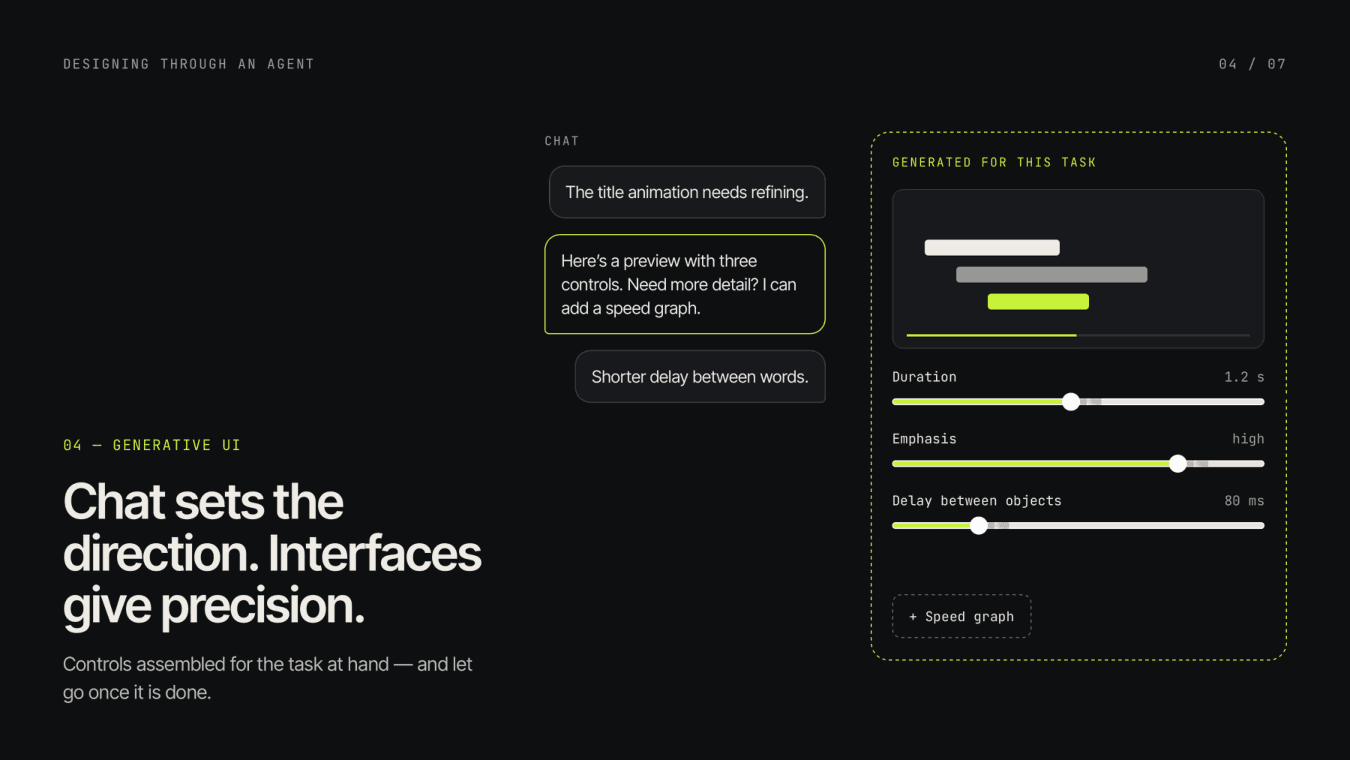
This is where Generative UI comes in: an interface created or assembled in the context of the current task.
Suppose an agent has prepared an animation. To help refine it, it could present a preview and a few controls: duration, emphasis and the delay between objects. If more detailed adjustments are needed, it could add a speed graph or an editable motion path.
Conversation sets the direction, while visual controls allow precise adjustments. Once the task is complete, that particular interface may no longer be needed.
For interface design, this creates an interesting challenge in its own right. Designers will need to consider which controls are useful in a given situation, when to show them and how much complexity to expose.
The Designer Directs the Process
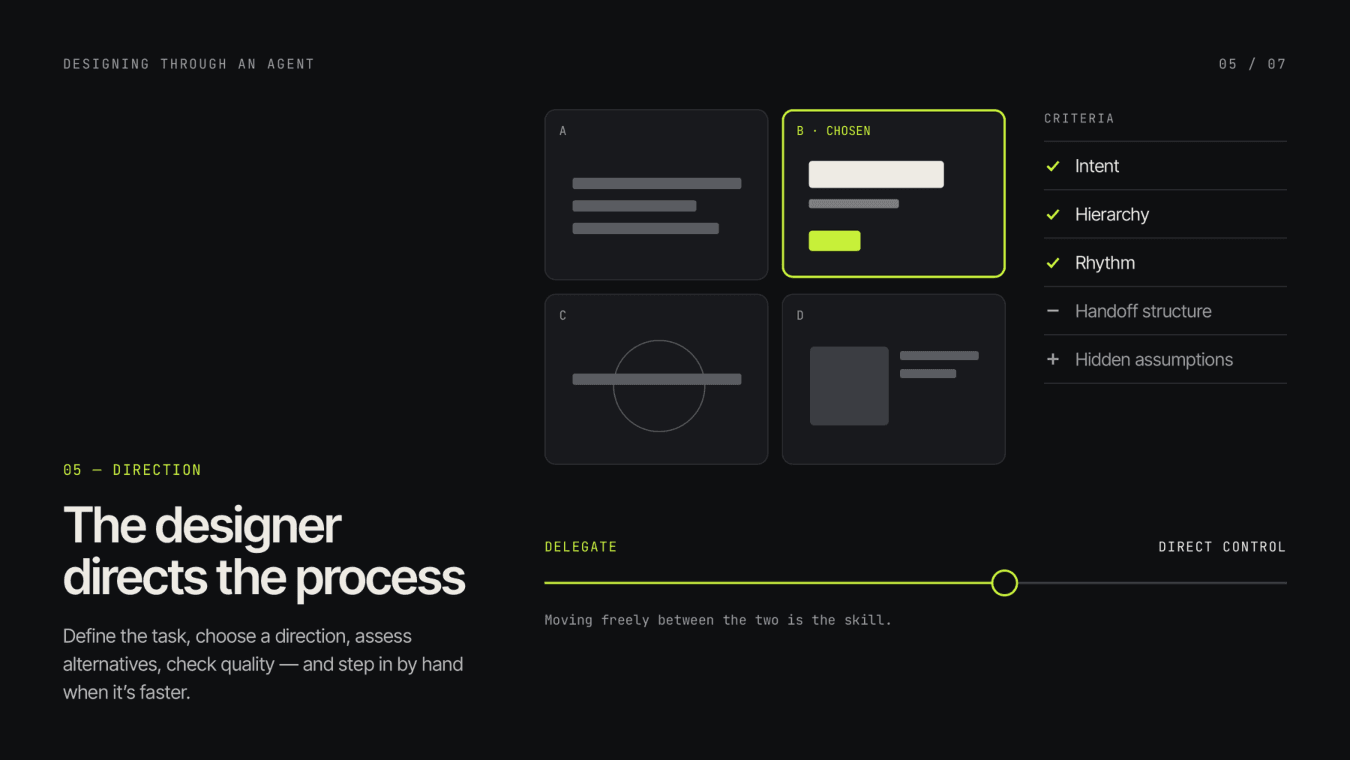
As an agent performs more operations, the designer’s attention shifts. More time can go towards defining the task, choosing a direction, assessing alternatives and checking quality.
In this sense, the work moves closer to directing. The designer needs to understand what the result should be, which decisions will lead to it, and why a proposed solution does or does not work.
Professional knowledge of the tools remains useful. Recognising a problem in animation requires an understanding of movement. Assessing an edit requires a sense of rhythm. Accepting a technically usable project requires knowledge of how it should be structured and handed over.
Hands-on work still has a place, too. Sometimes it is quicker to make a precise adjustment yourself. Sometimes exploring a solution directly in the application is necessary. What becomes more valuable is the ability to move freely between delegation and direct control.
The Boundaries Between Specialisms Expand
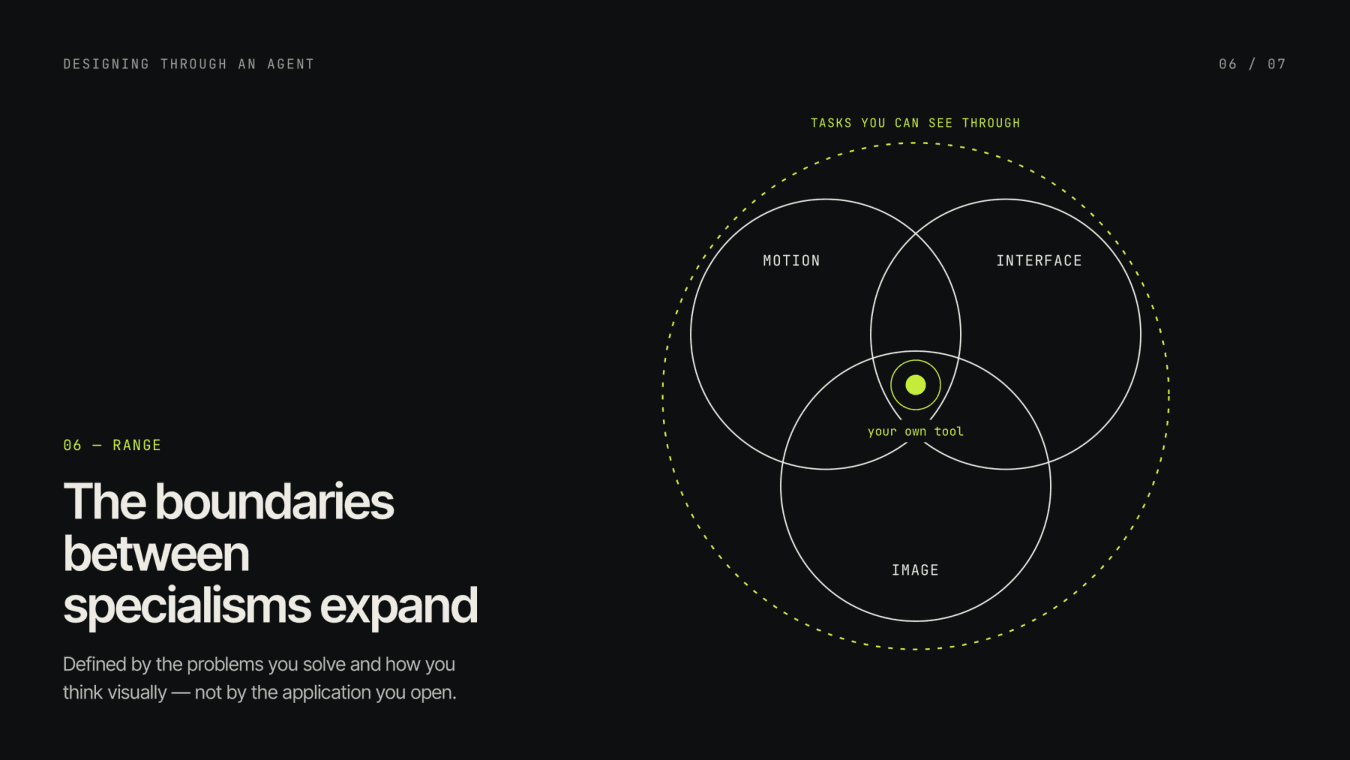
Agents also lower the barrier to working in neighbouring disciplines. A motion designer can build a small tool for preparing source material. An interface designer can create an interactive prototype with unusual behaviour. A designer working with still images can try animation without first learning the entire production process.
This does not make someone equally skilled in every discipline. It does, however, broaden the range of tasks they can see through to completion.
The ability to create custom tools is particularly significant. A recurring operation can become a script, a panel or a separate utility with a suitable interface. Designing the workflow itself becomes an accessible part of design practice.
Specialisation may increasingly be defined by the problems someone solves, their visual thinking and their depth of understanding. The name of the application they use will describe a smaller part of what they can do.
What Will Determine Quality?
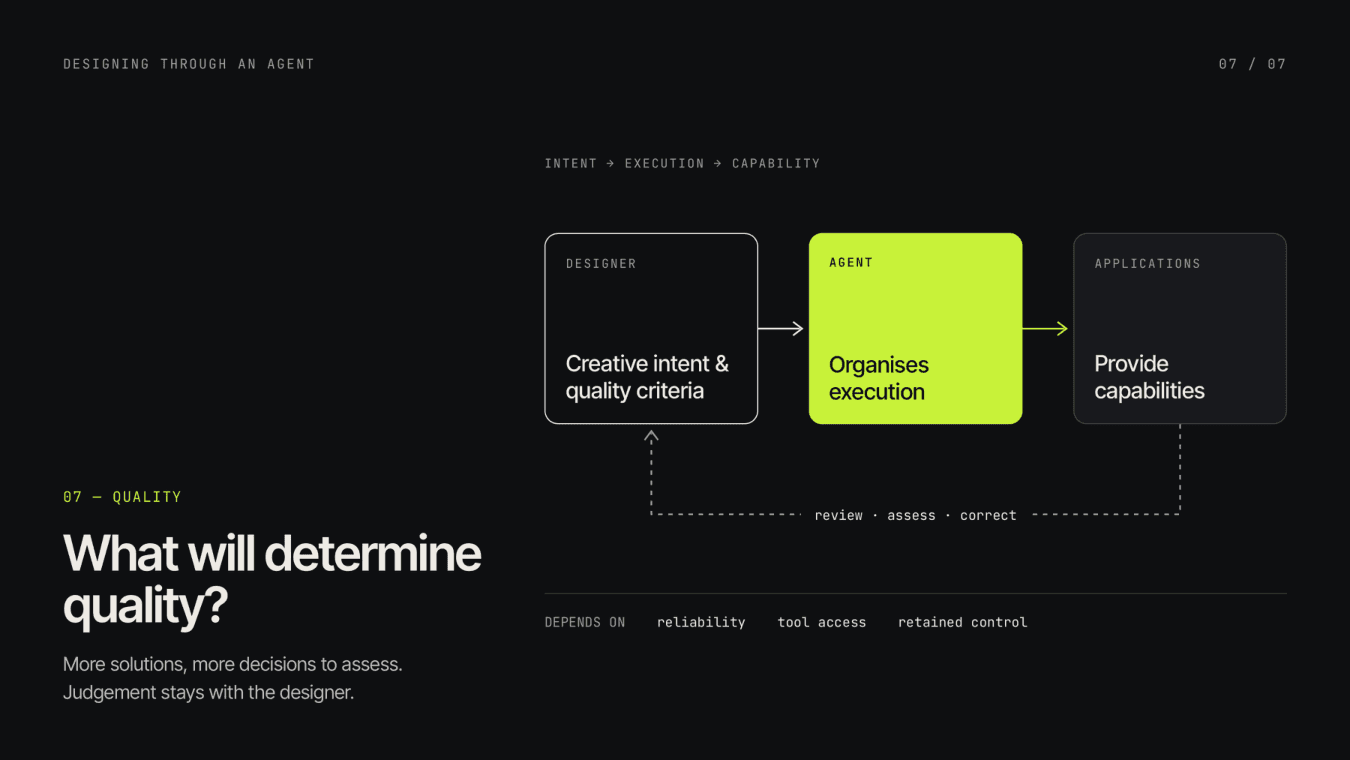
In this model, execution becomes more accessible and the number of possible solutions grows. So does the number of decisions that need to be assessed.
The designer still has to understand the task, choose a visual language, establish hierarchy, judge rhythm and recognise where the work loses its meaning. They will also need to assess the agent’s decisions: what it understood correctly, where it made a mistaken assumption and which errors sit behind a convincing preview.
The move towards working through agents should therefore be understood as a change in how work is organised. Some operations are delegated, new forms of control emerge, and access to tools expands.
The direction of this shift can be described as follows: the designer establishes the creative intent and quality criteria, the agent organises execution, and the applications provide the necessary capabilities. How far this model develops will depend on agents’ reliability, access to tools and how effectively people can retain control over the result.